


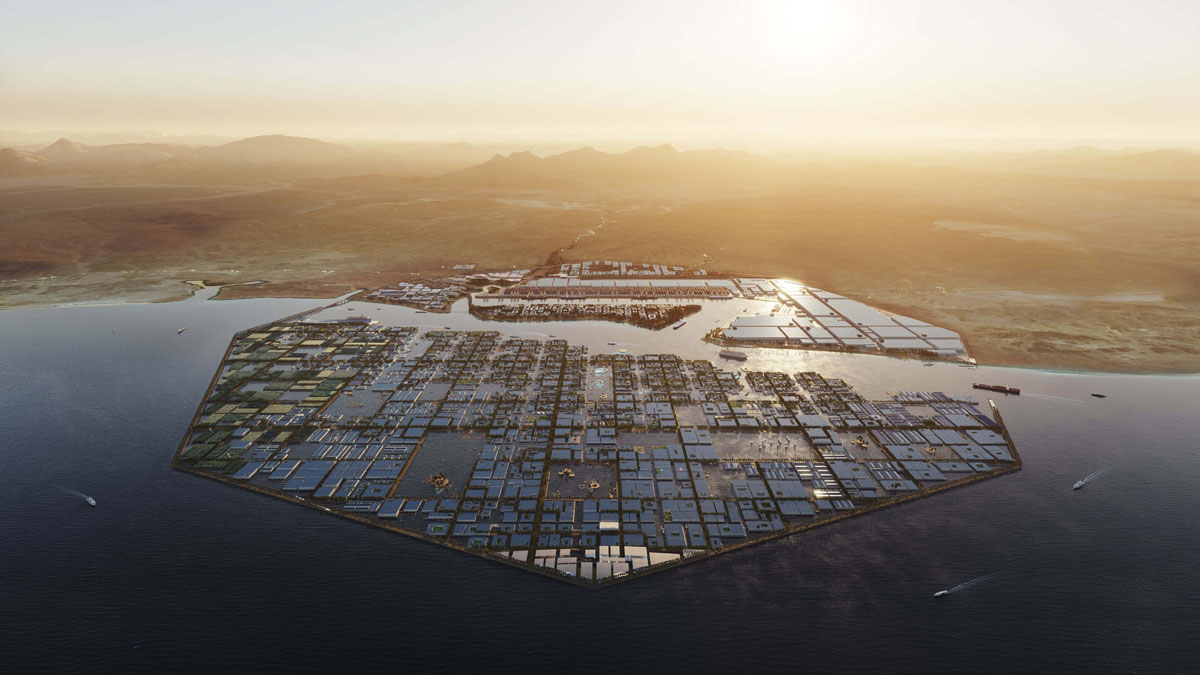
DataVolt committed $5 billion to NEOM's OXAGON in February 2025, when the Strait of Hormuz was carrying ninety-five tanker transits a day and a Red Sea industrial port looked like the least necessary thing Saudi Arabia could build. Twelve months later, Hormuz carries approximately 3.6 per cent of its pre-war commercial traffic, NEOM has cancelled more than $8.45 billion in contracts elsewhere, and OXAGON - the unglamorous, logistics-first zone that never featured in the drone footage - is the only part of the megaproject whose commercial thesis the war has strengthened rather than destroyed.
Before the IRGC closed Hormuz on February 28, 2026, OXAGON’s commercial case rested on a bet that most energy analysts treated as a hedge against a scenario nobody expected to materialise. The pitch was straightforward - a Red Sea industrial zone with deepwater port access, positioned to bypass the Strait of Hormuz for Saudi exports to Europe and Africa - but the logic required a chokepoint disruption that hadn’t occurred since the Tanker War of the 1980s, when the geography of Gulf shipping was simpler and the volumes were a fraction of what they became.
OXAGON’s defenders pointed to the data-centre thesis: the zone’s access to submarine cables, abundant solar and wind resources, and empty land made it a natural destination for hyperscale AI infrastructure regardless of what happened in the strait. DataVolt’s $5 billion agreement, announced in February 2025 and confirmed by Data Center Dynamics, MEED, and four other publications, was the clearest expression of that logic - a 1.5-gigawatt campus whose commercial viability depended on power and connectivity, not on tanker traffic.
Read the full story at House of Saud